Construction’s Biggest Companies Still Believe in SEO. Their Websites Don’t Always Show It. - AltCMO Construction Marketing and Fractional CMO Services
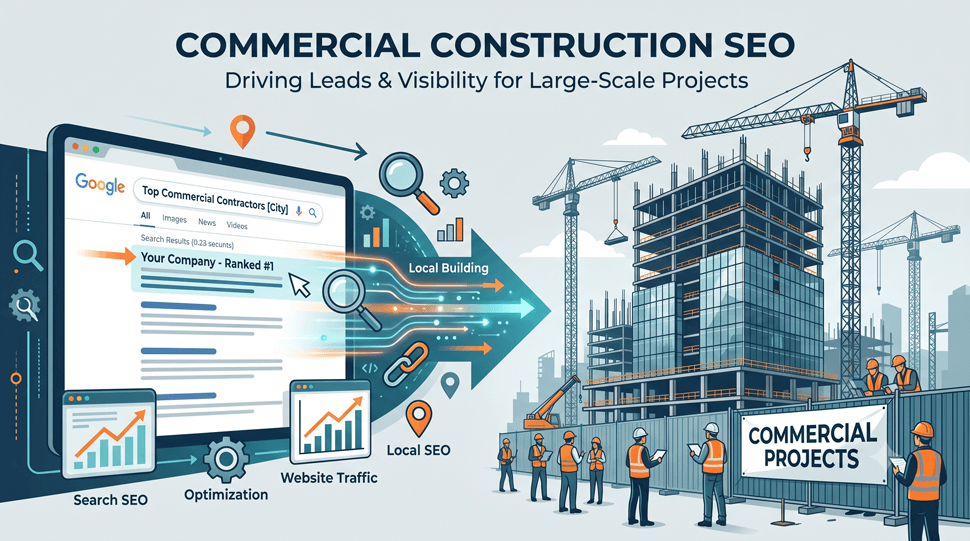
Construction’s Biggest Companies Still Believe in SEO. Their Websites Don’t Always Show It.
For the third year in a row, I spent several weeks studying the digital performance of the largest construction companies in the country. It is not glamorous work. There are no hard hats, drone shots, or ribbon cuttings. It involves a lot of spreadsheets, browser tabs, speed tests, backlink profiles, and repeated checks to make sure that one odd number isn’t distorting the entire dataset.
But the work keeps answering a question construction executives and marketers continue to ask: Does SEO still matter in an industry built on relationships?
The data says yes. The largest contractors in the country continue to invest in building digital authority. Their websites earn links, rank in search, and reinforce the reputations they have spent decades building offline.
Our 2026 Construction SEO Report analyzes the websites of the ENR Top 400 Contractors and compares their performance with the ENR Top 500 Design Firms. Architecture and engineering firms will receive their own dedicated report this year, allowing us to dig deeper into the differences between the two groups.
Three years of research have made one conclusion increasingly difficult to dismiss: market leadership and digital authority tend to travel together. Yet this year’s report also exposed a crack in that foundation.
Construction websites are getting slower.
The more things change, the more they stay the same
The ENR rankings change every year. Roughly 10% of the firms on the lists are new, but the larger SEO picture remains remarkably consistent.
Nearly eight out of 10 ENR Top 400 contractors have a Domain Authority score above 30, a level generally considered strong for a professional services company. Not one contractor in the Top 50 fell below that mark, and that has been true in all three years of our research.
The companies at the top have not stumbled into those scores. Digital authority takes years to build through project coverage, industry recognition, thought leadership, association involvement, community engagement, and backlinks from credible websites. It compounds much as a company’s reputation does.
A contractor that has earned thousands of legitimate links from trade publications, clients, partners, news outlets, and industry organizations has an advantage that cannot be replicated by launching a new website and adding “SEO” to the marketing budget for six months.
That is the encouraging part of the report. Large construction companies understand that their online presence matters. The less encouraging part is that many of them are allowing the technical performance of those websites to move backward.
Construction’s mobile website problem is getting worse
The average mobile website speed score among the ENR Top 400 Contractors fell from 57 in 2025 to 52 in 2026. A five-point decline may not sound dramatic until you look closer.
The lowest mobile score in the study was 3. Not 30. Three.
Only four of the 400 contractor websites achieved a perfect mobile speed score of 100. Desktop performance also declined, falling from an average of 73 last year to 68 this year.
This is happening while websites, hosting platforms, image-compression tools, content delivery networks, and performance-monitoring software are getting better. Improving website speed should be easier than it was five years ago, not harder.
Instead, many contractor websites have become digital equipment trailers. Every department has tossed something inside, nobody wants to throw anything away, and opening the door takes longer every year. Marketing wants larger project photography. Recruiting adds videos. Operations wants safety resources. Business development adds market pages. Leadership requests an animated homepage. Someone installs another tracking script, and nobody measures what the growing pile does to performance.
Then the company wonders why visitors leave.
A slow website is not merely an inconvenience. It affects search visibility, user experience, recruiting, and the likelihood that a visitor will reach out before losing patience. Nearly half of searches now happen on mobile devices, including owners researching contractors, recruits evaluating employers, project partners looking for qualifications, and referral sources trying to send someone to the right company.
Your reputation may have earned the visit. Your website still has to keep it.
Everyone wants an AI strategy. Start by fixing the website.
AI has made construction companies interested in search again, although many are approaching it backward. Executives who ignored traditional SEO for years are suddenly asking whether they appear in ChatGPT, Gemini, Claude, or Perplexity.
That is a fair question. AI is already changing how buyers research companies and how candidates investigate potential employers.
But AI search is not a replacement universe floating above the web. It relies heavily on the same authority signals that have always mattered: credible websites, expert content, backlinks, clear structure, factual detail, trust signals, and technical accessibility.
Everyone wants an AI-search strategy. Half the industry still has a website that loads like it is connected through a jobsite trailer fax machine.
Before you form an AI committee or hire someone to sprinkle the latest acronym across your marketing plan, make sure your website works. Can search platforms crawl it? Can someone use it on a phone? Does it clearly explain what your company does better than its competitors? Does it document expertise that currently lives only in your employees’ heads? Does it contain enough proof for a buyer, or an AI platform, to trust what you claim?
AI visibility is not a shortcut around SEO. It raises the standard for doing SEO well.
Relationships still matter. Search protects them.
Construction remains a relationship-driven industry, but the role of the website has changed. A referral used to create a phone call. Today, it usually creates a search.
The referred prospect visits your website, looks at your projects, checks your leadership team, reads your market experience, and compares you with two or three other companies. They may also look at employee reviews, LinkedIn activity, safety performance, awards, and recent news. All of this can happen before your business development team knows the opportunity exists.
A strong digital presence does not replace the referral. It confirms that the person who made the referral knew what they were talking about. A weak presence introduces doubt.
That same pattern applies to recruiting. A project manager or superintendent considering a move is not relying solely on a job posting. Candidates are researching project types, company stability, culture, advancement opportunities, and leadership. Increasingly, they are using AI tools to summarize those findings.
A company may have an exceptional culture, deep expertise, and a strong safety record. But when that knowledge is undocumented, search engines cannot rank it, AI platforms cannot cite it, and candidates cannot find it.
Expertise that exists only inside your company does very little to build authority outside it.
Smaller contractors have a legitimate opening
The size of the companies in this study can make the benchmarks feel intimidating. The median ENR Top 400 contractor has a Domain Authority score of 32 and 1,255 backlinks. Those figures reflect years of visibility, major projects, dedicated marketing teams, and public relations budgets that smaller contractors may not have.
Trying to beat those companies on broad terms such as “commercial general contractor” is usually a waste of money. You do not have to beat them everywhere. You have to become more relevant somewhere.
A regional contractor can build authority around a specific geography, project type, client problem, or area of expertise. A company that consistently publishes useful information about healthcare construction in a single metro area can become more relevant to that buyer than a national contractor with a single generic healthcare page.
Smaller firms can also compete on speed. The average mobile score for the country’s largest contractors is only 52. A focused regional contractor with a lean, well-maintained website can outperform much larger companies without matching their marketing budget.
That is the opportunity hidden inside this year’s decline. Large firms have greater authority, but that authority does not excuse a poor experience. Search engines do not award bonus points because your revenue begins with a billion.
A fast, specific, useful website can still beat a large, slow, generic one.
SEO is not a website project
Many contractors treat SEO as something completed during a website redesign. The new site launches. The leadership team approves it. Marketing checks the project off the list, and everyone moves on until the website becomes embarrassing enough to be replaced again.
That is not an SEO strategy.
Authority is built continuously through project case studies, expert articles, press coverage, awards, market-specific pages, technical improvements, and credible links from other organizations.
Website performance also requires maintenance. Images accumulate. Plugins age. Scripts multiply. Technology changes. Pages that loaded quickly at launch become slower two years later because nobody was assigned to keep measuring them.
The companies gaining ground are not necessarily doing anything exotic. They are paying attention. They know their Domain Authority. They monitor mobile performance. They understand where backlinks are coming from. They publish current content, compare their performance with competitors, and make incremental improvements.
Meanwhile, the companies losing ground often discover the problem only after traffic, applications, or opportunities decline. By then, the digital gap is not a technical issue. It is a business development issue.
The 2026 benchmark
The Construction SEO Report 2026 includes the complete findings from our research into the ENR Top 400 Contractors, including Domain Authority benchmarks, backlink averages and medians, spam-score findings, desktop and mobile website speed data, the relationship between traditional SEO and AI visibility, practical ways smaller contractors can compete, and the steps construction marketers can take to strengthen authority.
The report will not tell you that SEO is dead, that AI changed every rule, or that one clever tactic will put your company above billion-dollar competitors next month. The data does not support any of those claims.
It supports something less exciting and more useful: strong construction companies build authority over time, and the firms that consistently document their expertise, improve their websites, and earn credible visibility are easier to find, easier to trust, and easier to choose.
Large contractors are still investing in SEO. The question is whether the experience they are building online deserves the reputation they have earned offline.
Keep reading
August 9, 2026
The Backlog Iceberg: What Construction Leaders Miss About Winning Work - AltCMO Construction Marketing and Fractional CMO Services
July 26, 2026
The Fastest Competitive Divide Construction Has Ever Seen - AltCMO Construction Marketing and Fractional CMO Services
July 20, 2026
The Real Cost of Not Having a CRM in Construction - AltCMO Construction Marketing and Fractional CMO Services
Ready to build momentum?
Tell us where you are today. You get one reply from a marketing executive, not a sales rep.
 5.0 rating
from contractors
Our Trusted Clients


