

When I was working as a marketing director at a building product manufacturer, I kept hearing the same questions from contractors through our sales team. The same concerns. The same confusion. The same problems.
And I realized something obvious that most building materials companies still miss today.
Our SEO strategy was completely disconnected from what contractors actually needed to know.
We were creating content like “5 tips to winterize your deck.” Generic. Safe. Optimized for keywords that looked good in a spreadsheet.
But contractors weren’t asking about winterizing tips. They were asking specific questions that would make or break their projects.
The Product-Problem Gap That’s Costing You Leads
Here’s what contractors were actually searching for when they found our wood cladding and decking products:
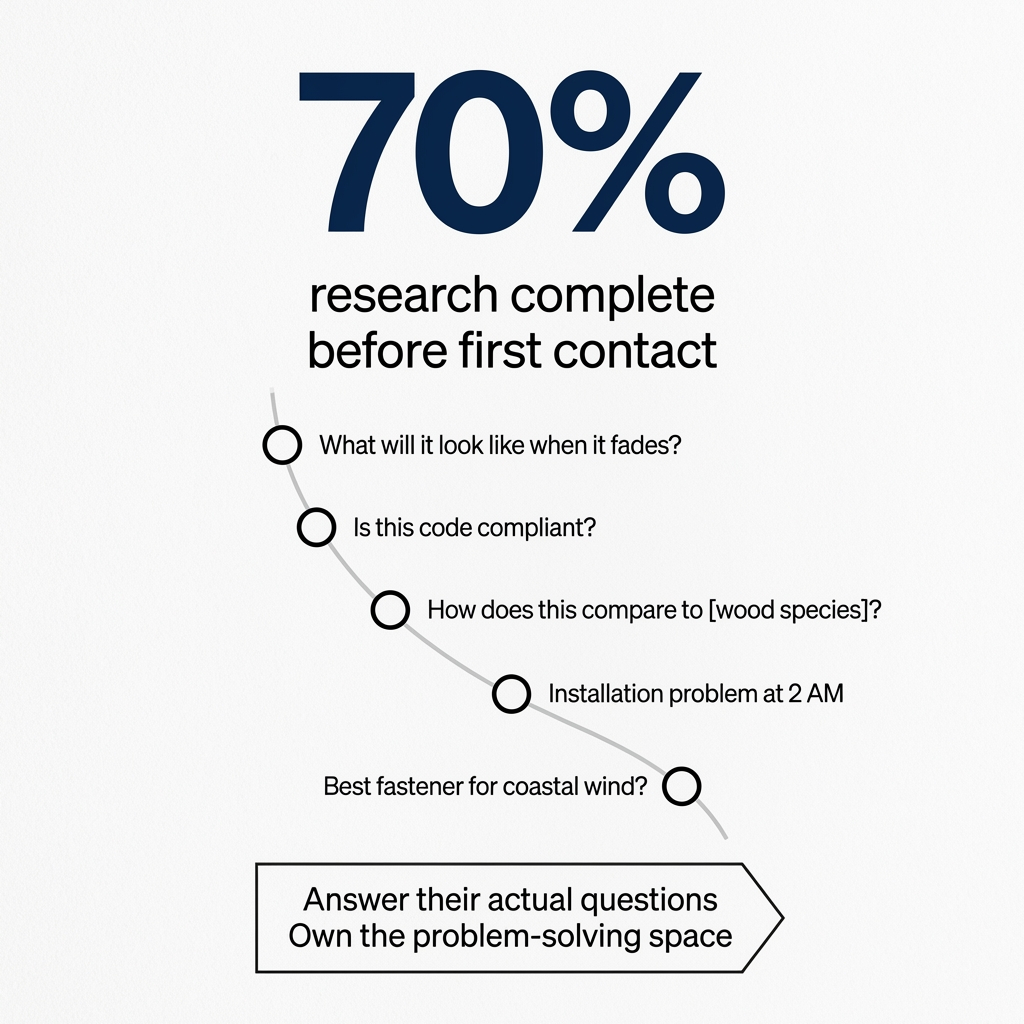
“What will it look like when it fades?”
“Is this code compliant in my area?”
“How does this compare to [specific wood species]?”
These weren’t product searches. They were problem searches. Decision searches. Searches happening at critical moments when contractors needed answers to move forward.
And here’s the thing that should terrify every building materials company: B2B buyers complete 70% of their research before they ever contact sales.
If your content isn’t answering their actual questions during that research phase, you’ve already lost.
Even worse: 81% of B2B buyers already have a preferred vendor by the time they reach out for first contact. They’re not calling to learn about options. They’re calling because they’ve already decided you’re the answer.
The question is whether your content helped them reach that conclusion.
Why Question-Based Content Beats Product SEO Every Time
When we shifted from generic content to problem-focused answers, something immediate happened.
Contractors started making decisions faster. They reached conclusions before talking to sales. The back-and-forth shortened. The closing rate improved.
The first thing you notice is the knowledge your leads have about your product before they ever pick up the phone to talk to you.
They’re not calling to ask basic questions anymore. They’re calling ready to buy.
This isn’t just anecdotal. Question-based search queries make up approximately 27% of all searches, yet they’re significantly easier to rank for. They require a domain authority of only 39 compared to 58 for traditional two-word keywords.
Translation: while your competitors fight over “wood decking” and “exterior cladding,” problem-focused questions sit wide open.
This represents a massive competitive blindspot in the building materials industry.
The 2 AM Installation Problem Search
Here’s where the real opportunity lives.
When contractors search at 2 AM, they’re not browsing. They’re not researching competitors. They’re dealing with a problem happening right now on the job site.
The most common searches? Installation problems.
What type of fastener to use. How to fasten the decking or cladding. Why something isn’t working the way they expected.
We created videos that complemented install guides. Short. Specific. Addressing common installation hang-ups rather than expecting installers to read through a 40-page PDF to find one answer.
This approach did two things:
First, it helped with rankings. Google loves content that directly answers specific questions.
Second, it changed the relationship. When a contractor finds your answer at their moment of crisis, you’re not just a supplier anymore. You’re the company that saved their project at 2 AM.
That’s a different kind of brand loyalty.
Breaking Down the Install Guide Into Searchable Answers
Most building materials companies have install guides. They’re buried in PDFs. Comprehensive. Technically accurate. Completely unsearchable.
We atomized the install guide.
Instead of one massive document, we broke it into individual problem-solving pieces. Blog posts. Videos. Each one addressing a specific installation challenge.
When a contractor searches “how to fasten wood cladding in high wind areas,” they don’t want to download a PDF and search through 30 pages. They want the answer. Now.
This isn’t just better for users. It’s better for SEO. Each specific problem becomes its own ranking opportunity. Each answer becomes its own entry point into your ecosystem.
Translating Code Compliance Into Human Language
Code compliance questions are incredibly specific. Different for every region. Most building materials companies look at this and think it’s impossible to create content for every local code variation.
They’re asking the wrong question.
You don’t need to create thousands of pages. You need to translate code-specific information into digestible language that answers the real concern.
Here’s a concrete example from our wood decking work:
Most manufacturers would say “We have ICC-ESR Certification” and expect contractors to understand why that matters.
We reframed it: “Is your decking code compliant?”
Because here’s what contractors actually care about: will this project get shut down by a building inspector?
Most contractors don’t understand the importance of ICC-ESR certification. But they absolutely understand the risk of a failed inspection. They understand project delays. They understand the margin hit when they have to rip out non-compliant materials.
When you translate technical certifications into the problems they solve, you create content that ranks for how people actually search.
The Biggest Mistake Building Materials Companies Make
After years of working with building materials manufacturers through AltCMO, I see the same mistake repeatedly.
Companies try to make their content appeal to everyone.
They write for architects and contractors and homeowners and distributors all in the same piece. The result is content that’s too generic to help anyone make a decision.
When I advise a building materials company on their SEO strategy, the first thing I ask is simple:
What are the top 5 questions your sales team gets?
Start there. Create content around those questions first.
Not “5 tips for better decking.” Not “The ultimate guide to exterior cladding.” Not content designed to rank for broad keywords.
Content that answers the specific problem for a specific person.
Because here’s what the data shows: over 70% of AEC professionals complete their initial product research independently before contacting manufacturers. They’re making specification decisions based entirely on what they can find online.
If your content doesn’t answer their specific questions, they’re specifying your competitor’s product before you even know they’re researching.
Why Most Manufacturers Throw Up White Papers and Hope
Building materials companies love white papers. Technical documents. Detailed specifications.
They upload them to their website and wonder why nobody reads them.
The problem isn’t the information. It’s the format.
Contractors don’t want to read a 20-page white paper to find out if your product meets local fire codes. They want a direct answer to a direct question.
Take the code-specific information from your white papers. Break it down. Translate the jargon. Answer the underlying concern in plain language.
This isn’t dumbing down your content. It’s respecting your audience’s time and meeting them where they actually search.
The Framework for Problem-First SEO
Here’s how to shift from product-focused SEO to problem-focused SEO:
1. Talk to your sales team
They hear the same questions repeatedly. Document them. Those questions are your content roadmap.
2. Identify the real concern behind each question
When a contractor asks “what will it look like when it fades,” they’re really asking “will my client be disappointed in six months?”
Answer the underlying concern, not just the surface question.
3. Break down your technical documents
Take your install guides, white papers, and spec sheets. Extract every problem they solve. Create individual pieces of content for each one.
4. Use the language contractors actually use
Not industry jargon. Not marketing speak. The exact phrases they type into Google at 2 AM when they’re stuck on a job site.
5. Make it visual
Videos. Photos. Diagrams. Contractors are visual learners dealing with physical products. Show them, don’t just tell them.
6. Measure what actually matters
Not just rankings. Not just traffic. Look at lead quality. Sales cycle length. The knowledge level of inbound leads.
What Changes First When This Strategy Works
You’ll know problem-focused SEO is working before you see the analytics.
The first indicator is the quality of conversations your sales team has with leads.
Leads start asking better questions. They’ve already done their research. They understand your product’s advantages. They’re calling to discuss implementation, not to learn basics.
The sales cycle shortens because you’ve already addressed the common objections and concerns through content.
The close rate improves because leads are self-qualifying before they ever reach out.
This is what happens when your SEO strategy aligns with how contractors actually search and make decisions.
The Competitive Advantage Sitting In Plain Sight
Most building materials companies are still optimizing for product keywords. Still creating generic content. Still uploading PDFs and hoping for the best.
This creates an opportunity.
While your competitors fight over “commercial roofing materials” and “exterior siding options,” you can own the problem-solving space.
You can be the answer when a contractor searches “why is my EIFS cracking around windows” or “how to prevent ice damming with metal roofing” or “best fastener spacing for coastal wind loads.”
These searches have intent. They have urgency. They lead to decisions.
And right now, in most building materials categories, they’re wide open.
Why This Matters More in 2024 and Beyond
The buying journey has fundamentally changed.
Contractors don’t want to talk to sales reps until they’re ready. Research shows that 75% of B2B buyers prefer a rep-free sales experience.
But here’s the paradox: buyers are 1.8 times more likely to complete a high-quality deal when they engage with supplier-provided digital tools.
They don’t want to be sold to. But they desperately need help making complex decisions.
Problem-focused SEO content is how you provide that help without pressure. You guide without pushing. You educate without selling.
And when they’re ready to buy, you’re the obvious choice because you’ve already proven you understand their challenges.
The Simple Truth About Building Materials SEO
Your customers aren’t searching for your products.
They’re searching for solutions to their problems.
The companies that win are the ones that show up with answers at the exact moment those problems occur.
Not with product brochures. Not with generic tips. Not with buried PDFs.
With specific, actionable answers to the exact questions contractors are asking.
Start with your sales team’s top 5 questions. Create content that directly answers those questions. Use the language contractors actually use. Make it visual and digestible.
That’s not just better SEO.
That’s how you become the trusted advisor instead of just another supplier.