
I’m watching construction companies make a dangerous assumption right now. They hear that ChatGPT and Perplexity are answering client questions, so they conclude traditional SEO doesn’t matter anymore. They’re abandoning the technical infrastructure that determines whether AI systems can even access their content in the first place.
Here’s what’s actually happening: 65% of Google search results now include AI Overviews. Your prospects researching complex mechanical systems or design-build approaches are getting AI-generated answers before they see your website in traditional results. But those AI answers still pull from somewhere. The question is whether they’re drawing on your documented expertise or on your competitor’s generic content.
The technical gap construction leaders create when they abandon SEO shows up in three ways.
First, AI systems prioritize fast websites because speed reduces computing costs. If your project portfolio loads slowly, you’re already filtered out before content quality even comes into play.
Second, AI systems scan for structural signals (headlines, lists, alt tags, & schema markup). Poor site architecture makes your content unreadable to the systems that decide what to cite.
Third, domain authority and backlinks signal credibility to both traditional search engines and AI language models. You can’t build citation authority on a technical foundation that’s falling apart.
The E-E-A-T Framework Construction Companies Miss
Most contractors have the experience. Decades of completed projects, specialized trades, and years solving complex problems on job sites. What they don’t have is that experience documented in ways AI systems recognize as expertise.
Google and AI both evaluate content through the E-E-A-T framework: Experience, Expertise, Authoritativeness, and Trustworthiness.
For construction companies, this translates directly.
-
Experience means documenting project spotlights, case studies, and field insights, not just listing what you built, but explaining how you solved specific problems.
-
Expertise requires highlighting certifications, safety credentials, trade specializations, and years of documented work.
-
Authoritativeness comes from awards, media mentions, and backlinks from respected industry sources.
-
Trustworthiness demands accurate, up-to-date information with clear contact details, team bios, and client testimonials.
I’ve seen legitimate companies with 30 years of project experience get passed over in AI citations because they have no projects documented on their website, no social posts, no articles or presentations, and no awards listed. The expertise exists offline, but AI systems can’t cite what they can’t access. You’re invisible by default.
Why Project Portfolios Come Before Thought Leadership
Here’s where most construction companies get the sequence wrong.
They start publishing blog posts about industry trends and innovative methodologies before they’ve documented a single completed project on their website. Without a project section, you look new and inexperienced. You lack the credibility to give your content any weight.
When I work with contractors who have decades of experience but no online presence, I prioritize building their project portfolio first. Not just any projects, projects that match their Ideal Client Profile. This builds credibility through keywords, locations, and demonstrated industry expertise. After that foundation exists, you can start publishing content about the industries or building types you prefer to work on. The credibility flows from documented projects to content authority.
But there’s a bigger distinction between project pages that check SEO boxes and project pages that feed AI systems the signals they need.
-
Traditional SEO-optimized project pages focus on project name, location, size, services provided, and maybe a generic description.
-
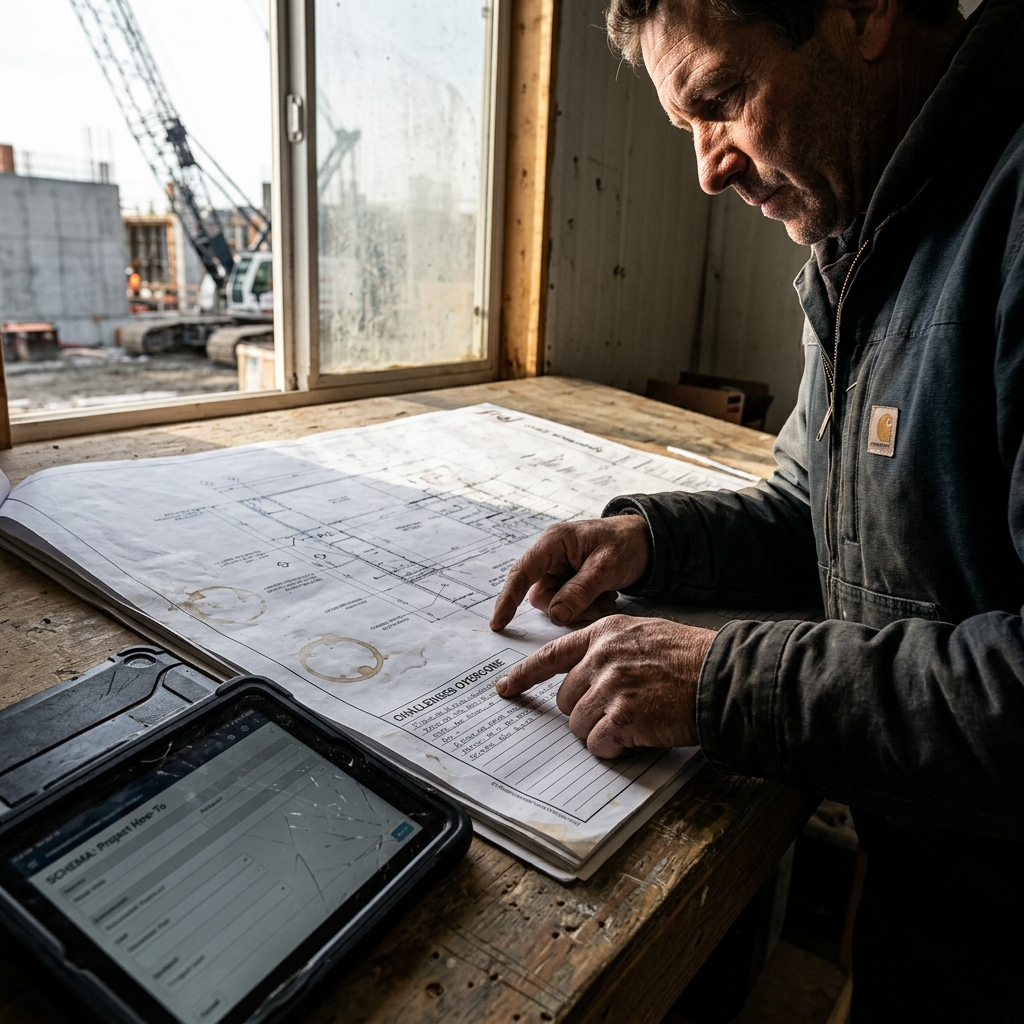
AI systems are scanning for something different: challenges overcome, new methodologies, creative problem-solving approaches, and unique solutions. They’re looking for “how we solved this” rather than “what we built.”
This creates tension. Construction companies resist documenting challenges and creative approaches because they worry that it reveals proprietary methods or makes them look imperfect.
I ask them a direct question: Do you want to remain a commodity fighting for low bids, or do you want to be sought after as problem solvers who get paid for their value? The latter attracts better talent, too.
When you document real problem-solving, you signal to both prospects and potential employees that you handle complexity.
The Self-Qualification Effect
When contractors make the shift and start documenting problem-solving approaches, something counterintuitive happens. Lead quality and applicant quality both increase, but the quantity sometimes drops. People filter themselves out. Prospects who want the cheapest bid realize they’re not the right fit for you. Job seekers looking for easy work go elsewhere.
This is where construction leaders panic. They see lead numbers drop and want to revert to generic messaging.
I point them to different metrics: qualified opportunities and the project size of quoted projects, not lead volume. AI search traffic converts 4.4 times better than traditional organic traffic because prospects researching via AI have already self-qualified through more sophisticated queries. They arrive with clearer intent.
The measurement challenge gets more complex when you factor in zero-click results. AI answers questions without generating clicks to your website. Your impressions increase, but clicks drop, and traditional analytics dashboards interpret this as declining performance even when your content is being used inside AI responses. You need new success metrics that capture influence when AI cites your methodologies without sending traffic.
Search Everything Optimization as a Strategic Framework
The framework I use with construction clients is Search Everything Optimization. You’re building content infrastructure that serves traditional search, AI retrieval, and direct discovery simultaneously without diluting technical depth or authority.
Here’s how it works in practice. Take a complex mechanical system installation—the kind of specialized work that differentiates your firm. You document the project with real expertise, preferably including an opinion on methodology. You show documented experience through specific challenges and solutions. You format it cleanly with proper headlines, structured lists, and schema markup so both search engines and AI systems can parse the content efficiently.
The opinion component matters more than most contractors realize. Opinions are memorable. They stand out.
If a general contractor published content arguing that design-bid-build should be abolished, that’s a strong stance many agree with, but few say out loud. It immediately separates you from competitors hedging with “it depends on the project.” Bold positions documented with expertise create citation-worthy content.
Schema markup plays a specific technical role here. The FAQ page and the How To schema explicitly signal the content structure to AI systems. Structured data implementation results in a 73% increase in AI Overview citations.
When you publish project case studies without schema markup, you forfeit the machine-readable signals AI systems require for confident citation. The content might be excellent, but it’s structurally invisible.
Minimum Viable Cadence for Citation Momentum
Construction companies with limited marketing resources ask me what the minimum viable content cadence looks like. What actually builds citation momentum versus just checking boxes that AI systems ignore?
One blog post per week from a subject matter expert, one project post per month. That gets the ball rolling. The blog posts need to be real expertise—preferably opinions on methodology, approaches to common challenges, positions on industry practices. The project posts need to document problem-solving, not just project specs.
Timeline expectations matter here. When you commit to documenting bold positions and SME expertise, you’re looking at 2-3 months before you see a shift in quality. It compounds over time with consistency. This isn’t instant visibility. You’re building the technical infrastructure, and content signals that AI systems need to recognize you as an authoritative source worth citing.
Construction companies abandoning SEO while competitors build expertise-driven content are creating a permanent disadvantage in both human- and AI-mediated discovery. Technical SEO remains the foundation. AI systems can’t cite content they can’t access, parse, or verify.
The contractors documenting real expertise with proper technical infrastructure aren’t just optimizing for today’s search; they’re building the citation authority that determines visibility for years.