
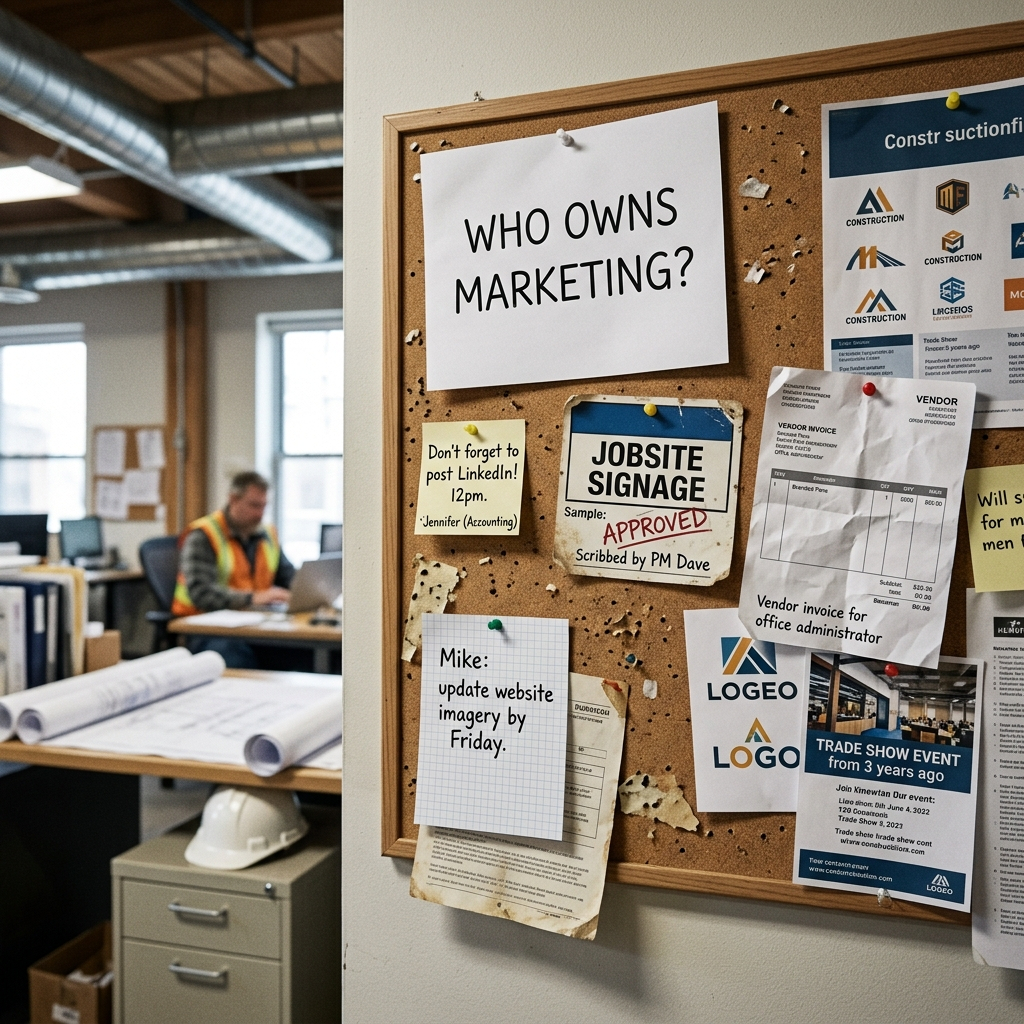
I need to tell you about a conversation I’ve had at least fifty times before. A construction CEO called me frustrated because their marketing wasn’t working. They’d tried LinkedIn. They’d redesigned the website twice. They’d hired three different agencies over five years. Nothing moved the needle.
Then I asked the question that always reveals the real problem.
“Who owns marketing at your company?”
The answer came back in pieces. “Well, Jennifer in accounting posts on social media when she has time. Mike’s been handling the website updates because he set it up originally. Our business development guy approves the brochures. And I write LinkedIn posts when I remember.”
What he described wasn’t a marketing department. It was a collection of tasks that landed on whoever happened to be nearby when someone said, “We should probably do something about that.”
How Your Marketing Structure Happened By Accident
Nobody planned this. Nobody sat down and said, “Let’s distribute our marketing across five different people with completely unrelated job descriptions and see what happens.”
It evolved organically.
Three years ago, the CEO started posting on LinkedIn after a meeting was canceled and someone suggested he should have a presence there. Now that’s apparently his job. The office administrator orders branded merchandise because she ordered it once in 2019, and everyone assumed that it became her responsibility. The project manager handles jobsite signage because he’s on-site, and it seems logical. The business developer works with the first graphic designer to respond to their email.
From a distance, this looks like a system. The same way a pile of rocks looks like a wall if you squint. But it’s not load-bearing anything.
Here’s what makes this particularly dangerous. Because tasks are getting completed, leadership assumes the marketing function exists. Someone posts content. Someone orders materials. Someone updates the website. Marketing must be happening.
When results don’t follow, you blame the tactic. LinkedIn doesn’t work. Trade shows are dead. Nobody reads newsletters anymore. The industry is too relationship-based for this brand stuff.
You never question whether the problem is structural.
The Diagnosis Everyone Misses
I’ve watched construction companies spend years trying different tactics, switching agencies, and experimenting with new platforms. They treat marketing like a slot machine. Pull the lever enough times with enough different coins, and eventually something pays out.
The real problem is that nobody with marketing expertise is making decisions.
When I dig into what “we tried Google ads” actually means, I find that an admin set up a campaign based on what seemed logical, ran it for 6 weeks, got 3 leads that didn’t close, and declared that paid search doesn’t work in construction.
Nobody defined the ideal client profile first. Nobody built a landing page designed for conversion. Nobody set up proper tracking. Nobody knew what the cost per lead would be to make the math work. Nobody planned a nurture sequence for leads that weren’t ready to buy immediately.
What failed wasn’t the tactic. What failed was the complete absence of expertise and strategy.
You have three compounding problems:
-
Nobody owns marketing with actual authority. The tasks are distributed across people whose primary jobs are completely different. Marketing always gets done in the gaps, with whatever energy remains after their real responsibilities are handled.
-
Nobody has the specialized knowledge required. Your office administrator isn’t failing at marketing. She’s succeeding as an office administrator who also got handed a task requiring expertise she wasn’t hired for.
-
Nobody defined what success looks like. You have no ideal client profile. No positioning strategy. No messaging framework. No brand voice. Nothing that would allow disconnected activities to build on each other or point in the same direction.
You’re flying blind and calling it a test.
What This Actually Costs You
The costs of operating without real marketing structure don’t show up on a line item labeled “marketing dysfunction.”
They show up as revenue you didn’t close. Talent you couldn’t attract. Pricing pressure you couldn’t resist. Bids you feel like you have to pursue to keep the backlog up. A grinding feeling that growth is harder than it should be.
You burn through clients faster than you’d like because you’re attracting the wrong ones. The price shoppers and project hoppers who don’t value what you do differently. You lose work you should win because you can’t articulate why you’re the right choice before the conversation turns to cost.
You work harder than your competitors to achieve the same results.
I see this most clearly in hiring patterns. Construction companies with no real brand, no defined culture, and no clear market positioning struggle to attract people who want to build something meaningful. They get applicants who need a job, not people who chose them specifically.
That difference compounds over the years into a team that’s competent but not committed. Present but not passionate.
The best people in this industry want to work for companies that stand for something. Construction companies that have a reputation worth being part of. That can articulate what makes them different in a way that makes you want to be associated with that difference.
When your brand is whatever happens to be true about you at any given moment, you’re not giving anyone a reason to choose you over the dozen other contractors hiring for the same role.
The pricing pressure follows the same pattern. When you can’t differentiate yourself clearly, when your marketing materials look like everyone else’s because they were created by people copying what everyone else does, you compete on price. Price becomes the only variable clients can compare directly.
You know you’re better. You know you deliver more value. You know your projects run smoother and your quality is higher.
But if you can’t communicate that in a way that lands before the bid gets submitted, none of it matters.
The Foundation Work You’re Avoiding
Here’s what fixes this, and I’m going to be direct because I’ve seen too many companies waste years avoiding the obvious answer.
You need to define your brand foundation before you do anything else.
That means identifying your ideal client profile with enough specificity that you can make decisions about who you’re for and who you’re not for. Not “commercial construction clients in the Southeast.” That’s not specific enough to guide decisions.
It means articulating your positioning in a way that’s defensible, distinct, and actually true. Not aspirational nonsense about being the best or the most trusted or the leading provider of whatever. Real positioning that differentiates you by what you can actually deliver.
It means developing a messaging framework that captures how you talk about your work. The problems you solve. The value you create. The reasons someone should choose you over the alternative. In language that resonates with your ideal client, not language that sounds impressive in a boardroom.
And it means documenting your brand voice and personality so that everything you put out into the world sounds like it came from the same company. Whether it’s a LinkedIn post, a proposal, or a jobsite sign.
This is the work nobody wants to do because it feels like a strategy instead of an action. Like planning instead of building. And construction companies are culturally biased toward doing rather than overthinking.
But skipping this step is why your marketing accumulates instead of compounds.
Without a foundation, every tactic is a one-off. Every campaign starts from zero. Every piece of content is disconnected from the last one. Nothing builds equity over time.
You spend energy without creating momentum. You check boxes without moving toward a destination. And you wonder why you’re exhausted but not further along than you were last year.
What Changes When You Do This Right
The companies I work with that actually invest the time to define their brand foundation properly describe the shift as clarifying.
Decisions get easier because you have criteria to evaluate against.
Should we sponsor this event? Does it put us in front of our ideal client profile? Should we pursue this project? Does it align with our positioning, or are we chasing revenue that will dilute our reputation? Should we hire this person? Do they embody the values and voice we’ve defined as core to who we are?
The foundation doesn’t just improve your marketing. It improves every client-facing and team-facing decision you make.
You’ve finally named what you’re building instead of just reacting to whatever opportunity or crisis shows up next.
Your proposals start sounding like they come from a company with a point of view rather than a vendor listing services. Your team can articulate your value proposition without checking with leadership first. Your reputation precedes you, so clients seek you out rather than you always chasing the next opportunity.
These aren’t theoretical possibilities. They’re the predictable outcomes of doing the foundational work that turns random acts into a compounding strategy.
The Path Forward Requires Honest Assessment
I need you to hear this clearly. The slog you’re experiencing isn’t normal. It’s not an inevitable feature of the construction industry, the current market, or the way things have to be.
It’s a symptom of operating without structure in a function that requires it.
You’re treating marketing as a side task rather than a strategic capability. You’re assuming effort is enough when what you actually need is expertise applied consistently over time toward a defined outcome.
There’s an easier way to do this. It requires investment, both financial and attentional. It requires admitting that the accidental structure you have now isn’t working, even if it feels like you’re doing something.
It requires bringing in someone who owns marketing with actual authority. Or partnering with people who have the expertise to build the foundation you’re missing. Or at minimum, stopping the random acts long enough to define what you’re trying to build before you build more of it.
The path forward isn’t more tactics. It’s not another website redesign, another social media platform, or another trade show booth.
It’s stepping back long enough to answer the foundational questions you’ve been avoiding because they felt too abstract or too strategic or too far removed from the immediate pressure to just do something that might work.
What would change if you actually knew who you were for, what you stood for, and how to communicate that consistently across every touchpoint?
What would shift if your team could articulate your value proposition without hesitation? If your proposals reflected a clear point of view? If your reputation made clients seek you out instead of you always chasing the next opportunity?
Those outcomes are available to you. They require doing the foundational work that turns accidental structure into intentional strategy.
The question is how much longer you’re willing to operate with a structure that’s holding you back when the alternative is defining what you’re building and building it properly.