
I analyzed the websites of ENR Top 400 contractors to understand which trust signals are prioritized, and the results surprised me. These trust signals are must-haves for my clients’ websites, yet the largest contractors in the industry aren’t implementing them.
The data reveals a profound disconnect between what construction companies showcase and what prospects actually need to reduce perceived risk. Safety records and awards dominate dedicated pages, appearing on 89.25% and 85.25% of websites, respectively. Core values show up on 77.75% of sites with dedicated pages.
But here’s where it gets interesting.
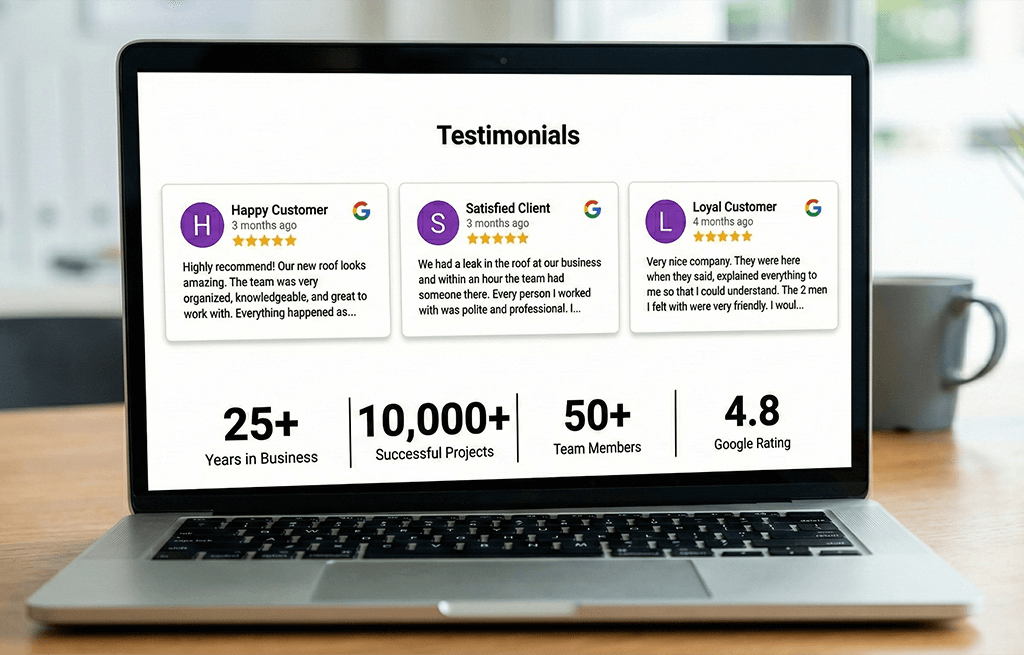
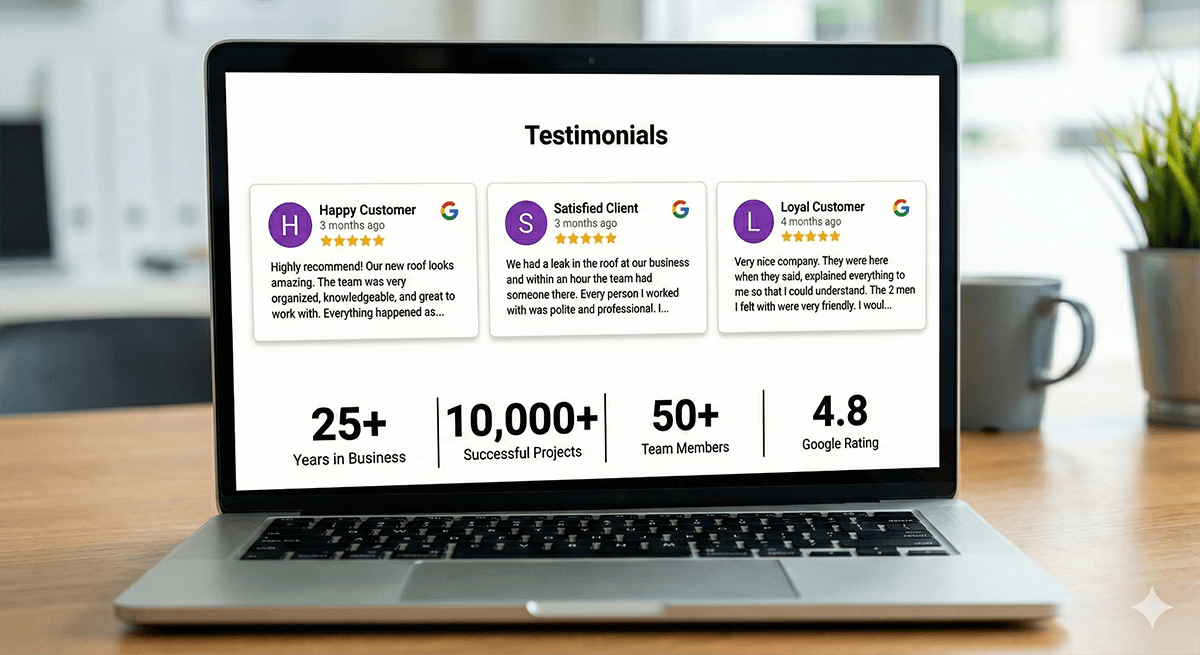
The most persuasive trust signals (testimonials, client logos, and quantifiable proof points) remain conspicuously absent on over 80% of contractor websites.
The Buyer Psychology Gap
My clients don’t ask me to include trust signals on their websites; I place them because I know their buyers want to see these trust signals, as they build credibility and trust. As buyers, we want third-party validation, and we’re willing to pay more for demonstrated expertise.
Buyers look for specific proof points that reduce perceived risk enough to influence pricing: awards, certifications, safety programs, completed work like projects or metrics, and expertise demonstrated through blogs and resources.
The question becomes… why do contractors prioritize awards and certifications but skip the actual client voices and project evidence that would directly address a buyer’s “will they deliver for me” question?
The Research Expansion
I initially thought the missing trust signals might be a phenomenon unique to the largest contractors. Perhaps companies at that scale operated differently, relying solely on reputation.
I expanded the sample to 100 contractors with $100 million in revenue.
The results were nearly identical.
This pointed to something systemic: a disconnect between leadership that wants to appear humble and leadership that simply does not understand what buyers need. And buyers in this context include potential employees evaluating whether to apply for positions at these firms.
The Three Barriers to Client Validation
Testimonials present three distinct challenges for construction companies.
- The operational difficulty of collecting B2B testimonials because it requires coordination, follow-up, and persistence.
- The cultural discomfort with self-promotion, with some leadership teams fearing that showcasing client praise appears boastful.
- Competitive intelligence concerns about revealing client lists—gets cited most frequently. Leadership worries about handing competitors a roadmap to their relationships. But that’s the excuse, not the actual driver.
The Uncomfortable Truth About Client Relationships
Here’s what the data doesn’t explicitly show, but the absence of testimonials reveals: construction companies aren’t known for customer service. Commercial and civic projects span multiple years, and a lot can go wrong over that timeline. Almost every construction project goes over the initial budget and timeline.
The absence of testimonials may not be due to competitive intelligence at all. It might be about not wanting to initiate that conversation with a client who’s still processing the overruns, delays, and complications that inevitably arise in multi-year, multi-million-dollar engagements.
Very few contractors maintain strong accountability with their clients. That’s why client churn runs so high in the industry.
When a buyer visits a contractor’s website and sees safety records and awards but no client testimonials or completed project metrics, the website conveys a story of transactional relationships.
The contractor might think they’re communicating professionalism and capability, but they’re actually signaling that client relationships don’t extend beyond contract fulfillment.
The Path of Least Resistance
Safety pages should appear on 100% of contractor websites. Buyers understand that they pay more if a construction company maintains unsafe practices, as higher insurance premiums translate directly to project costs, and unsafe work conditions create additional risk and potential delays. Safety pages also function as recruiting tools, with prospective employees regularly visiting them to evaluate workplace culture.
The 89% adoption rate for safety pages makes sense when you understand the dual audience they serve.
But here’s the critical distinction. Safety pages can be manufactured internally and essentially templated. A safety manager can write the content, or a third-party provider can develop it. At this point, AI could write most safety pages because they say the same basic things across the industry.
My research didn’t evaluate the quality of content on safety pages, just whether they existed.
Testimonials, in contrast, require asking someone outside your organization to do something. They require external cooperation and expose you to what clients actually think. The 89% adoption rate for safety might be less about strategic credibility building and more about it being the easiest box to check.
Association Memberships and the Partial Presence Problem
The research showed that association memberships appeared as “partial presence” on about 50% of sites, not fully featured on dedicated pages, nor completely absent.
This turns out to be standard practice rather than a revealing pattern. Associations rarely deserve a dedicated page. Companies typically display them as logo collections in homepage footers or on about pages, signaling industry participation without providing an extensive explanation.
The AI Ranking Implications
Testimonials and awards function as huge credibility factors for human buyers, but they also matter for AI recommendations. AI systems crawl these sites and evaluate credibility signals to generate recommendations for users seeking contractor suggestions.
AI looks for logical reasons to include and rank recommendations. Awards and testimonials provide proof that you’re a quality contractor. I’ve observed this logic in testing results for my firm and clients: systems prioritize contractors who can demonstrate third-party validation over those relying solely on self-reported capabilities.
80% of contractors without testimonials are missing out on human buyer confidence and on AI confidently recommending them.
They may be deprioritized by AI systems that buyers increasingly rely on for vendor selection. The templated safety content that all sounds the same doesn’t carry the same weight in algorithmic evaluation as unique, specific client validation.
The Fundamental Misconception
After examining hundreds of contractor websites, analyzing adoption patterns across multiple trust signals, and testing how both human buyers and AI systems respond to different credibility markers, one insight stands out as the most fundamental error contractors make about trust signals.
They think they don’t need them because prospective buyers and employees already know their reputation.
This assumption reveals a critical misunderstanding of how modern B2B buying decisions actually work. Reputation might get you on a shortlist, but it doesn’t close deals or convince top talent to accept offers. The decision-maker evaluating your firm might be new to their role, unfamiliar with your market, or responsible for a project type you haven’t been associated with historically.
Your reputation exists in the minds of people who already know you.
Trust signals exist to reach everyone else, including the procurement manager at a company you’ve never worked with, the project owner expanding into your geographic market, the talented construction manager considering multiple job offers, and the AI system synthesizing recommendations from hundreds of data points.
The Differentiation Opportunity
The research reveals a massive opportunity for contractors willing to address the gap in testimonial and client validation. When 80% of your competitors avoid showcasing client voices and completed project metrics, implementing these trust signals creates immediate differentiation.
The barriers are real. Collecting testimonials requires operational discipline, featuring client work demands confidence in your relationships, and quantifying results means committing to transparency about outcomes. The difficulty of implementation doesn’t diminish the strategic value.
Buyers evaluate risk constantly throughout the selection process. Every missing trust signal increases perceived risk. Every present trust signal reduces it. The calculation isn’t complicated, but the industry continues to optimize for the wrong variables; prioritizing what’s easy to produce over what’s effective at reducing buyer anxiety.
The contractors who recognize this gap and systematically address it will not only improve their websites. They’ll fundamentally shift how prospects perceive their client relationships, their accountability standards, and their confidence in delivering results worth talking about.
Which raises the question, if your client relationships are strong enough to justify premium pricing, why wouldn’t they be strong enough to showcase?