
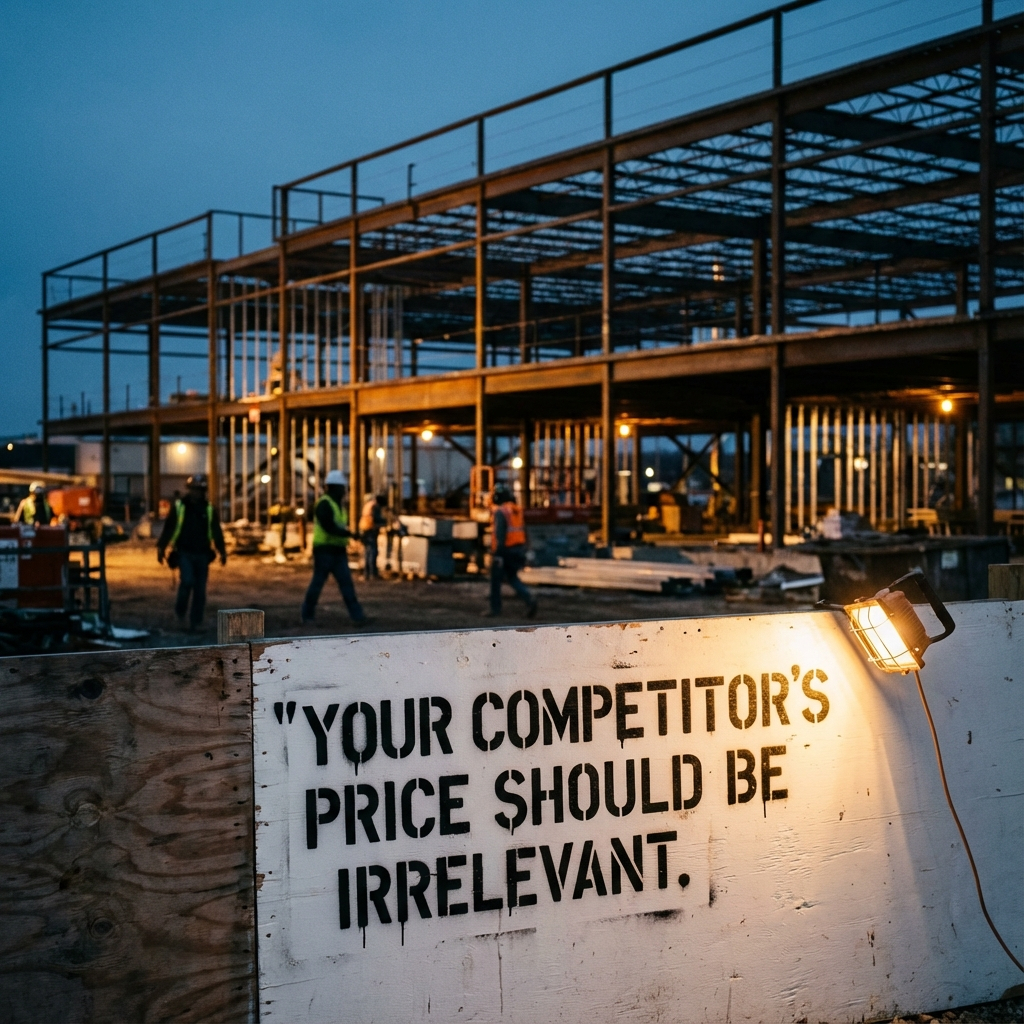

I regularly watch construction companies destroy themselves trying to guess what their competitors will bid so they can undercut them.
They spend hours obsessing over someone else’s numbers while ignoring their own margins, profitability, and actual costs. They’re flying blind in their own business, only to come in 0.01% lower than the competition.
It’s asinine.
I once witnessed two signage contractors literally put each other out of business by taking projects at a loss to prevent the other from getting the work. They destroyed each other out of spite as they raced to the bottom.
This is what happens when you compete on price alone.
The Industry Trained You Wrong
When I tell construction companies that their competitor’s price should be irrelevant, they look at me like I’m crazy.
“That’s how we’ve always done it,” they say.
When contractors underbid to win work, they cut corners, miss details in preconstruction planning, or encounter surprises that lead to costly change orders. The client who chooses based solely on price ends up paying more and having a worse experience.
Let your competitors low-bid on a project and take on that extra risk.
Good Clients Want to Pay You Fairly
Here’s what most contractors never communicate: good clients actually want to pay fairly.
Paying vendors fairly helps them stay in business, complete your project, retain employees, innovate, and care about your project.
When you’re the discounted client, you get the B team (or worse), and leadership ignores you.
Research shows that 86% of buyers will pay more for a great customer experience, and 68% will pay a premium for excellent service.
Early conversations about money serve as a filter that reveals which clients are bad before you waste resources on them.
If they balk at paying or try to string you along, they’re a bad client who doesn’t value your work. They will likely argue about requested change orders, pay late, and will be a pain in the ass to work with.
The “Freeconstruction” Problem
General contractors routinely give away preconstruction services to get new work.
The industry nicknamed it “freeconstruction”—a brutal acknowledgment that valuable strategic planning, estimating, design consultation, and risk analysis are given away for free to compete.
I’ve seen a shift toward paid preconstruction services in recent years, and it’s working.
The conversation is straightforward: you can provide a limited amount of preconstruction services at no cost, but to secure your best people and full attention, the client needs to pay for specific preconstruction phases.
You’re providing value for the cost and actively working to prevent change orders later, where the real nickel-and-diming occurs.
Make paying you good for the client.
This is common practice with other professional services. Nobody expects a software developer to write free code to see if they might get hired. They pay for scoping, then propose on the actual development project.
History Continually Proves Buyers Prefer Value
Burger King’s early positioning strategy offers a masterclass in value-based competition.
They charged more than McDonald’s by emphasizing “bigger, flame-broiled burgers made your way.” People told their leadership it would never work.
It worked because they delivered more value to their customers and communicated that value clearly.
They forced the differentiation. They didn’t wait for customers to notice; they made it impossible to ignore.
Every market has room for both the bargain and luxury versions. Contractors who adopt value-based pricing strategies achieve, on average, profit margins 20-30% higher than those competing on cost alone.
That’s not theory. That’s measurable financial performance.
Finding Your Flame-Broiled
When construction companies tell me, “We’re all building to the same code, using similar materials,” I ask why they’re a different company.
If you can’t answer that question, it would be easier to join forces than have separate companies competing all the time.
To find the real differentiation, I go back to the company’s origin story. I also ask recent hires, referral partners, and clients what stood out to them.
There’s always something there.
Sometimes it’s obvious, and leadership is too close to see it. Sometimes they take it for granted because they’ve done it that way for so long.
Leaders respond with “No shit! We should have known that.”
But then they doubt whether their actual differentiator matters to customers, even after customers literally told me that’s why they hired them.
That’s the gap between value delivery and value communication.
The Uncomfortable Decision
When a construction company finally commits to competing on value, screening out bad clients, and charging what they’re worth, it must first make an uncomfortable decision: to be different.
It’s scary because people feel safer being in the crowd, even if the whole crowd is racing to the bottom.
The companies I’ve worked with that broke away from that crowd mentality start seeing benefits within the first six months. After that first year, they question why they didn’t do it sooner.
Your competitor’s price should be irrelevant. Determine your construction costs, including materials, labor, support staff, overhead, and profit.
Then have the money conversation early. Make yourself a partner with the client instead of a vendor or worse, an enemy.
The client who respects that conversation is worth having. The one who balks isn’t.